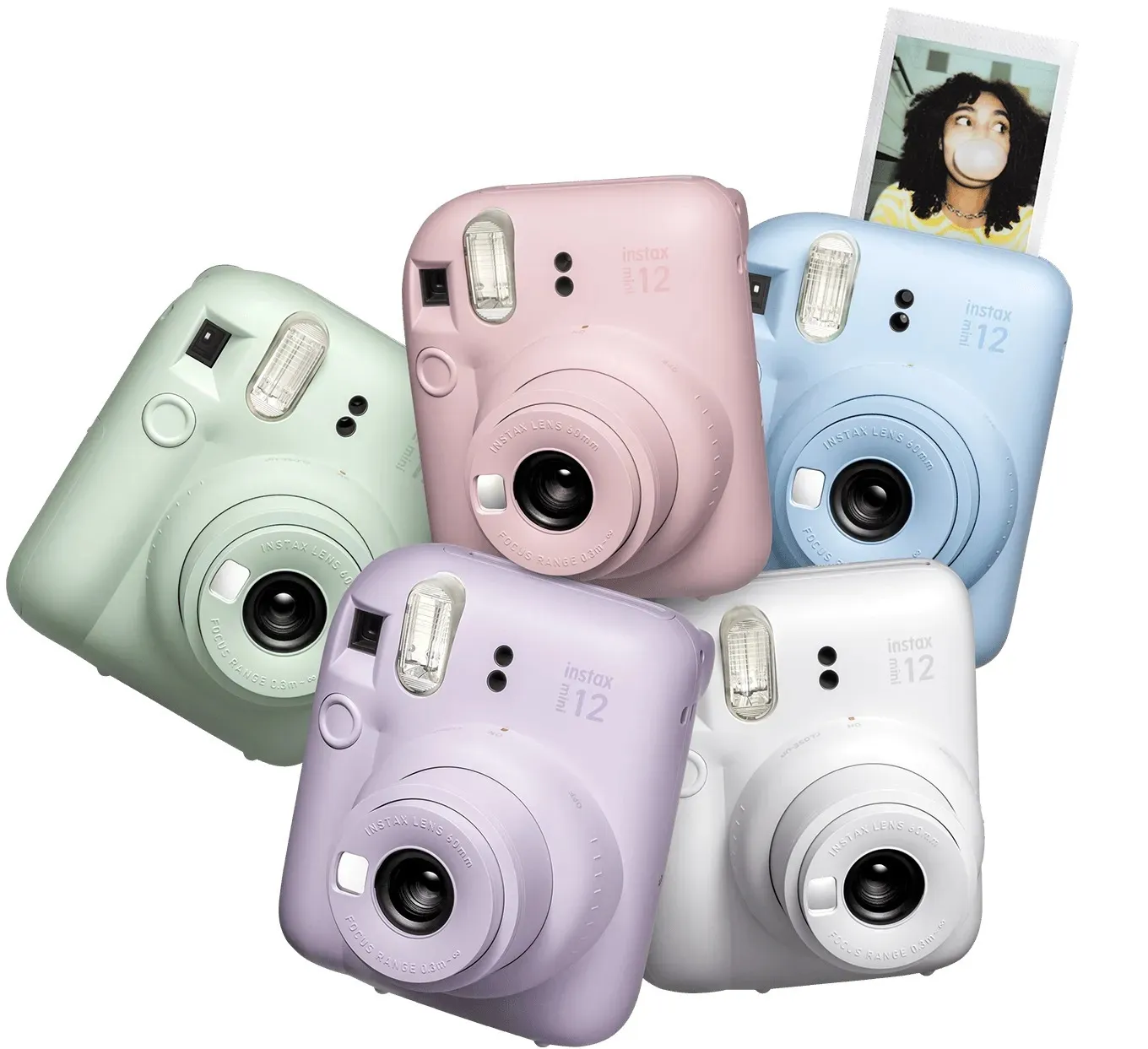
Fujifilm Instax Mini 12
Point, shoot, and hold a real print seconds later. No screen involved.
The simplest instant camera — no screen anywhere in the process, a real print in about 90 seconds, and a genuine per-shot cost to budget for.
Pros & cons
- No screen at any point in the process — you compose through an optical viewfinder and the result is a physical print, not a file
- Automatic exposure adjusts flash output for shooting distance, per manufacturer specifications, so most shots come out usable without manual settings
- Close-up/selfie mode with a built-in mirror for framing self-portraits without a front screen
- Runs on 2 AA batteries — no proprietary charger, no app pairing
- Each shot has a real, recurring cost — roughly $0.75–$1 per exposure for Instax Mini film, and there's no preview or delete button
- No exposure or focus control beyond the built-in automatic modes and a close-up switch
- Prints are small (credit-card sized) and can fade or shift color over years if not stored properly, per user reports
How it works
The Instax Mini 12 is a point-and-shoot instant camera: aim through the optical viewfinder, press the shutter, and the camera automatically measures the shot and adjusts flash output before printing, according to manufacturer specifications. A motorized print emerges from the front slot within seconds and develops fully over roughly 90 seconds. There is no screen anywhere on the camera — not to compose, not to preview, not to delete. What you shoot is what you get.
Film and the real cost per photo
The camera itself is inexpensive, but Instax Mini film is the ongoing cost: a twin-pack of 20 exposures typically runs $16–$20, putting each photo at roughly $0.75–$1. That's the tradeoff for a real, permanent print instead of a file — there's no way to review and delete a bad shot before it costs you film, which is either part of the charm or a real drawback depending on how deliberate you want to be about each shot.
Build and modes
Per manufacturer specifications, the Mini 12 adds automatic exposure detection over older Instax models, a close-up/selfie mode with a small mirror next to the lens for self-portrait framing, and a twist-to-power design that also caps the lens when off. It runs on 2 AA batteries rather than a proprietary rechargeable pack, trading some convenience for the ability to replace batteries anywhere.
Who should buy it
The Instax Mini 12 suits anyone who wants a real, physical photo from a moment — a party, a trip, a gift — without involving a phone screen, an app, or a cloud upload at any point. It's a strong pick for group settings (parties, weddings, classrooms) where the instant print itself becomes part of the moment.
Who should skip it
Anyone who wants the purest possible break from anything screen-adjacent, including the instant gratification of watching a print develop, may prefer the Kodak Snapic A1's fully delayed film-roll experience instead. Anyone shooting frequently enough that $0.75–$1 per photo adds up fast should budget for that before buying — it's a real, recurring cost, not a one-time purchase.
The bottom line
The Instax Mini 12 is the easiest, most reliable instant camera at this price. It has no screen at any stage, produces an actual object instead of a file, and asks nothing of you beyond aiming and pressing a button — the ongoing film cost is the one thing to budget for going in.
Vs. closest alternative
Instax Mini 12 and Kodak Snapic A1 both replace a phone camera with something that produces no on-device preview, but the delay is completely different. The Instax gives you a physical print in about 90 seconds — instant gratification, no screen, but a real per-shot film cost. The Snapic A1 is a 35mm reusable film camera: nothing develops until you finish the roll and get it processed, which can be days or weeks later. The Instax suits people who still want to see the result quickly; the Snapic suits people who want the delay itself as part of slowing down.
Point, shoot, and hold a real photo about 90 seconds later — the simplest, most reliable instant camera at this price.
FAQ
How much does it cost per photo?
Instax Mini film commonly sells in 20-exposure twin-packs for roughly $16–$20, which works out to about $0.75–$1 per photo. There's no way to preview or reshoot without using film, so that cost applies to every exposure, good or bad.
Does it have any manual controls?
Very few. Exposure and flash are automatic, and the only manual adjustment is a switch between normal and close-up/selfie focus modes, per manufacturer specifications. It's designed to be pointed and shot, not manually configured.
What batteries does it need?
Two AA batteries, which are not typically included with the camera. That's a tradeoff worth knowing: no proprietary charger to lose, but also no built-in rechargeable pack.